


Packaged Snack X-ray Inspection System: Improving Food Safety and Quality Control
1. Industry Background
Food manufacturers are under increasing pressure to control foreign-body contamination throughout the production and packaging process. For manufacturers producing packaged snacks, nuts, dried fruit, energy bars, biscuits and similar products, contamination may occur at several stages, including raw-material handling, cutting, grinding, mixing, conveying and packaging.
Metal fragments are only one part of the risk. Depending on the production environment, products may also be exposed to glass, stones, ceramics, hard plastics and other high-density foreign objects.
For this reason, an inline X-ray inspection system can provide an additional layer of food safety control after packaging. Unlike conventional metal detection, X-ray inspection can identify a broader range of dense foreign objects inside many types of packaging.
Fanchi-tech's X-ray inspection systems are designed for both packed and unpacked products and can inspect products in plastic packaging, boxes, metal foil and cans. The company's standard packaged-product systems also support automatic product learning, contamination analysis, data storage and multiple automatic reject configurations.
For food manufacturers supplying supermarkets, retailers and international markets, this type of inspection equipment can become an important part of a documented food safety and quality-control program.
2. Customer Production Challenges
Consider a typical packaged snack manufacturer producing products such as nut mixes, dried fruit, snack bags and energy bars.
The production process may include:
Raw Material Receiving → Cleaning → Processing → Mixing → Packaging → X-ray Inspection → Automatic Reject → Finished Product
The manufacturer may face several inspection challenges.
Foreign objects from raw materials
Nuts, dried fruit and other agricultural ingredients may contain naturally occurring stones or other dense foreign materials. Even when raw materials are carefully cleaned, contamination risks cannot always be completely eliminated.
Metal contamination from processing equipment
Processing equipment contains stainless-steel components, cutting tools, fasteners and other metal parts. Equipment wear or accidental damage can introduce metal fragments into finished products.
Non-metallic contamination
A traditional metal detector cannot provide the same level of protection against non-metallic foreign objects such as glass, stones or certain dense plastics.
Packaged-product inspection
Once the product has been sealed inside a pouch, tray, carton or other package, opening every package for manual inspection is impractical and would significantly increase labor costs.
Increasing production speed
Modern food production lines require continuous inspection without creating a bottleneck. The inspection system therefore needs to operate at a speed compatible with the upstream packaging line.
3. Why Traditional Inspection Methods May Not Be Enough
Metal detectors remain an important technology for food manufacturers, particularly when the primary contamination risk is metallic.
However, a metal detector is not designed to detect every type of dense foreign material.
For example, a packaged snack may contain:
- Stainless-steel fragments
- Ferrous and non-ferrous metal
- Glass fragments
- Stones
- Ceramic material
- High-density plastic
- Other dense foreign objects
X-ray inspection works by analyzing differences in X-ray absorption between the product and foreign materials. This allows the system to identify high-density contamination that may not be detectable using metal detection alone.
Fanchi-tech's standard X-ray inspection systems are designed to detect high-density materials including metal, ceramic, stone and hard rubber, while selected configurations can also address glass contamination.
This makes X-ray inspection particularly valuable for packaged food products where the manufacturer wants to extend contamination detection beyond metallic objects.
4. Fanchi-tech X-ray Inspection Solution
For a medium-size packaged food production line, the recommended solution is a standard conveyor X-ray inspection system, with the exact model selected according to package dimensions, product density, production speed and required detection performance.
The Fanchi-tech standard series includes several tunnel sizes. The FA-XIS4016 configuration, for example, provides a 400 × 160 mm inspection tunnel, a belt speed range of 10–70 m/min and a maximum load capacity of 10 kg.
The system is designed around continuous inline inspection.
Products enter the X-ray inspection tunnel on a PU anti-static conveyor belt. The X-ray generator and detector create an inspection image, while the software analyzes the image for contamination and other defined inspection conditions.
When a rejected product is identified, an automatic reject device can remove it from the production flow.
Depending on the product and production-line requirements, Fanchi-tech offers different reject configurations, including flipper, pusher, flapper, air blast, drop-down and heavy-pusher systems.
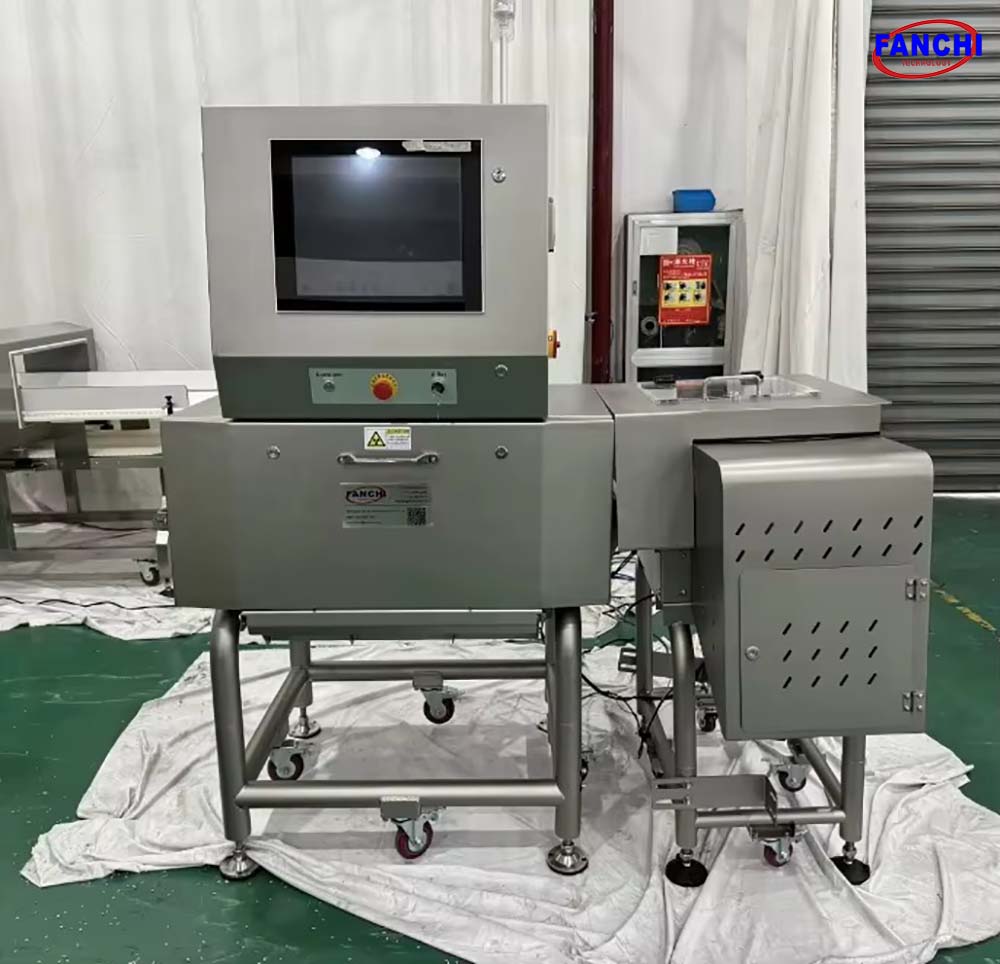
The machine shown in the supplied photograph has the overall structure of a conveyor-based packaged-product X-ray inspection system, including an integrated inspection cabinet, touchscreen control interface, conveyor and downstream reject section.
5. Machine Configuration Matching the Application
Recommended Application
Packaged Snacks, Nuts and Dried Fruit
This application is a good match for a standard conveyor X-ray inspection system because the products are typically processed and then packed before final inspection.
Recommended Configuration
| Parameter | Recommended Configuration |
|---|---|
| Equipment type | Conveyor X-ray Inspection System |
| Application | Packaged snacks, nuts, dried fruit and similar foods |
| Inspection stage | After packaging |
| Recommended tunnel | Around 400 × 160 mm for suitable medium-size packages |
| Conveyor speed | Up to approximately 70 m/min depending on configuration |
| Product load | Up to approximately 10 kg for FA-XIS4016 |
| Belt | PU anti-static conveyor belt |
| Detection | Metal and other high-density foreign objects |
| Reject | Pusher / flipper / flapper / air blast or other suitable configuration |
| Construction | Stainless steel |
| Control | Touchscreen HMI |
| Product memory | Up to 100 product presets on FA-XIS4016 |
The exact tunnel size and load capacity should always be confirmed against the customer's actual product dimensions and package configuration before quotation.
Fanchi-tech's standard product range extends from 300 × 120 mm tunnels through larger 800 × 300 mm configurations, with corresponding differences in belt speed and load capacity.
This is important because X-ray inspection equipment should not be selected simply according to the product name. The package dimensions, product thickness, density, orientation and line speed all affect the appropriate machine configuration.
6. Application Process
A typical production process can be arranged as follows:
Raw Materials
↓
Cleaning & Processing
↓
Mixing / Forming
↓
Packaging
↓
Sealing
↓
X-ray Inspection
↓
Automatic Reject
↓
Qualified Products
↓
Final Packing / Cartoning
The X-ray inspection system is normally installed after the product has been packaged.
At this point, every package can pass through the inspection tunnel without being opened.
If the system identifies a contaminated product, the automatic reject mechanism removes the affected package from the production flow.
This creates a closed-loop inspection process that is easier to document and manage than manual sampling alone.
7. What Can the X-ray System Detect?
For packaged food manufacturers, one of the major advantages of X-ray inspection is its ability to detect a broader range of dense foreign objects.
Depending on the product, packaging and selected system configuration, typical targets include:
Metal
The system can detect ferrous, non-ferrous and stainless-steel contamination. The standard FA-XIS4016 specification lists a stainless-steel test ball detection capability of 0.3 mm under defined test conditions.
Glass and Ceramic
Glass and ceramic are important contamination risks in food processing and packaging environments. The FA-XIS4016 specification lists a glass/ceramic ball test size of 1.0 mm under defined test conditions.
Stone
Stone contamination can originate from agricultural raw materials such as nuts, grains and dried ingredients.
High-Density Plastic and Rubber
Selected X-ray configurations can identify certain high-density non-metallic contaminants that would not be detected by a conventional metal detector.
The actual detection performance should always be validated using the customer's real product and packaging. Test samples are recommended before final equipment selection.
8. Automatic Reject and Production-Line Integration
Detection alone is not enough for a modern food production line.
The inspection system also needs to remove rejected products reliably.
Fanchi-tech X-ray systems support several automatic reject options, including flipper, pusher, flapper, air blasting, drop-down and heavy-pusher configurations.
The correct reject mechanism depends on the product.
For lightweight snack bags, an air-blast or flapper solution may be appropriate.
For heavier cartons or rigid packages, a pusher or heavy-pusher configuration may provide more controlled rejection.
For high-speed production, the reject mechanism should also be matched to product spacing and conveyor speed to avoid disturbing adjacent qualified products.
This is why Fanchi-tech recommends selecting the complete inspection solution according to the customer's actual production line rather than choosing a machine based only on tunnel dimensions.
9. Quality Control Beyond Foreign Object Detection
An X-ray inspection system can also support broader product-quality checks.
Depending on the software and application, X-ray inspection can be used to identify abnormal product conditions such as missing components, incorrect product quantity, abnormal fill level or product-position problems.
This allows manufacturers to move from simple foreign-object detection toward a broader product inspection and quality-control system.
For packaged food manufacturers, this can be particularly useful when several SKUs are produced on the same line.
Fanchi-tech systems provide automatic product learning and product memory functions. The FA-XIS4016 specification lists storage for up to 100 product presets, helping operators manage different products on the same inspection system.
10. Customer Benefits
Reduce Foreign-Object Risk
Continuous X-ray inspection provides an additional barrier against contamination reaching consumers.
Detect More Than Metal
Compared with metal-only inspection, X-ray technology can address a wider range of high-density foreign objects.
Support Food Safety Programs
Inspection records and automated rejection can support documented HACCP, BRC, IFS and retailer quality-control procedures.
Reduce Manual Inspection
Automated inspection reduces dependence on visual inspection and manual sampling.
Improve Production Efficiency
Inline inspection allows products to be checked continuously without stopping the packaging line.
Protect Brand Reputation
Reliable contamination control can reduce the risk of customer complaints, product recalls and retailer quality incidents.
Support Export Markets
For food manufacturers exporting to Europe, North America and other regulated markets, robust inspection and traceability systems can strengthen the overall quality-control program.
11. Why Choose Fanchi-tech?
Shanghai Fanchi-tech Machinery Co., Ltd. focuses on food inspection and product inspection equipment, including metal detectors, checkweighers and X-ray inspection systems.
The company's X-ray systems are designed for applications across food, chemical, cosmetic and pharmaceutical industries. The standard packaged-product systems use stainless-steel construction, industrial X-ray components and touchscreen operation.
Fanchi-tech also provides multiple tunnel sizes and reject configurations, allowing the equipment to be adapted to different product sizes and production requirements.
The standard system specifications include IP66 protection for the listed packaged-product models, stainless-steel 304 construction, USB/Ethernet connectivity and CE approval.
For an overseas food manufacturer, the most important point is not simply the machine itself but whether the supplier can match the inspection system to the actual product.
Fanchi-tech can therefore evaluate:
- Product dimensions
- Product weight
- Packaging material
- Product density
- Production speed
- Foreign-object risks
- Required tunnel size
- Reject method
- Production-line height
- Cleaning requirements
before recommending a final configuration.
12. Frequently Asked Questions
Can an X-ray inspection system inspect products in plastic packaging?
Yes. X-ray inspection is widely used for packaged food products in plastic bags, pouches, trays, cartons and other packaging formats. The appropriate configuration depends on the package dimensions and product characteristics.
Can X-ray inspection detect stainless steel?
Yes. Stainless-steel detection is one of the important applications of food X-ray inspection. The FA-XIS4016 specification lists a 0.3 mm stainless-steel test ball under defined test conditions.
Can an X-ray machine detect glass?
Yes. Glass and ceramic can be detected when the product, packaging and machine configuration provide suitable density contrast. The FA-XIS4016 lists a 1.0 mm glass/ceramic ball test specification under defined conditions.
What products are suitable for packaged food X-ray inspection?
Typical applications include snacks, nuts, dried fruit, biscuits, ready-to-eat meals, frozen foods, meat products, seafood and other packaged foods.
What tunnel size should I choose?
The tunnel should be selected according to the maximum product/package dimensions and required inspection geometry. Fanchi-tech's standard range includes 300 × 120 mm, 400 × 160 mm, 500 × 250 mm, 600 × 300 mm and 800 × 300 mm configurations.
How fast can a food X-ray inspection system operate?
The speed depends on the selected model. For example, the FA-XIS4016 has a belt speed range of 10–70 m/min, while larger configurations may have different speed ranges.
What is the maximum product weight?
The maximum load depends on the model. The FA-XIS4016 is specified for loads up to 10 kg, while larger models can support higher loads.
Can the X-ray machine automatically reject contaminated products?
Yes. Fanchi-tech offers different automatic reject mechanisms, including pusher, flipper, flapper, air blast and drop-down systems. The best option depends on the product weight, packaging format and production speed.
How do I choose the correct X-ray inspection machine?
Provide the supplier with the product size, package dimensions, product weight, packaging material, line speed and contamination types you need to detect. A product sample test is recommended before final selection.
Conclusion
For packaged snack manufacturers, food safety inspection is no longer limited to detecting metal contamination.
Products such as nuts, dried fruit, snack mixes and ready-to-eat foods can face contamination risks from metal, glass, stones, ceramics and other dense foreign objects throughout the production process.
A conveyor X-ray inspection system provides continuous inline inspection after packaging and can integrate automatic rejection into the production line.
For medium-size packaged products, a configuration such as the FA-XIS4016—with a 400 × 160 mm tunnel, 10–70 m/min belt speed and 10 kg load capacity—can be a suitable starting point, subject to product testing and final engineering confirmation.
The key to selecting the right system is not simply choosing the largest tunnel or fastest conveyor. The inspection system should be matched to the actual product, packaging, production speed, contamination risks and reject requirements.
Contact Fanchi-tech to evaluate your product and receive a customized X-ray inspection solution.
Company: Shanghai Fanchi-tech Machinery Co., Ltd.
Contact: Kerry
Email: kerry@fanchitech.net
WhatsApp: +86 13917555254
Website: www.fanchitechnology.com
Post time: Aug-21-2026