


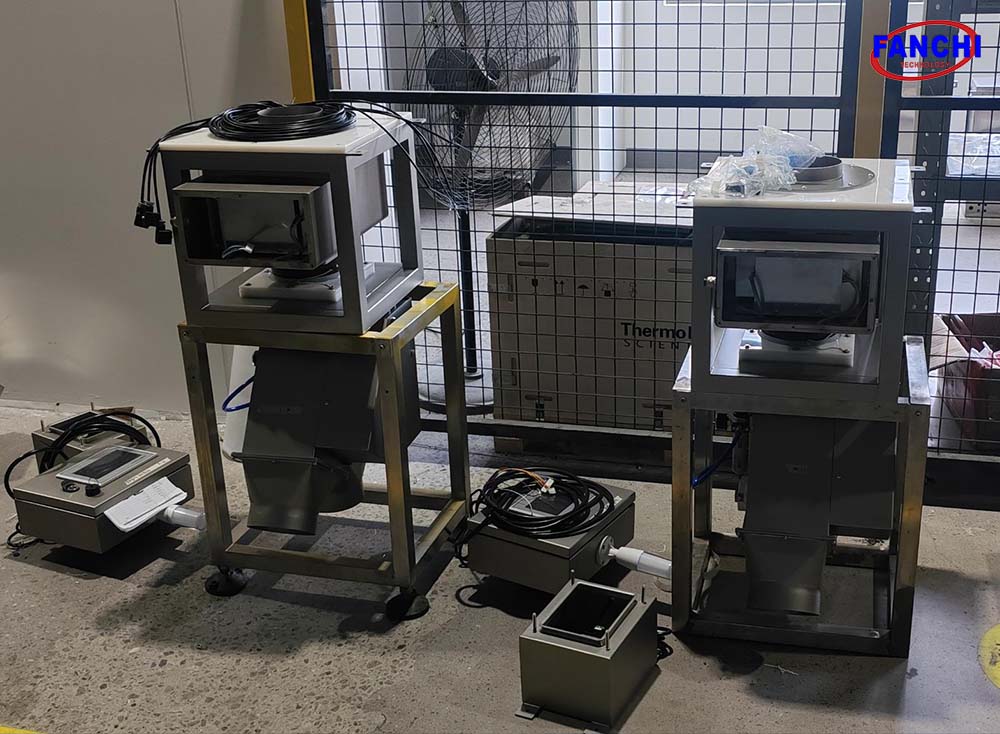
Gravity Fall Metal Detector for Seasoning Powder Production: A Complete Food Safety Case Study
1. Industry Background
Seasoning powder manufacturers face a continuous challenge: maintaining food safety while processing large volumes of dry ingredients at high production speeds.
Seasoning products such as spice blends, powdered flavoring, soup seasoning and dry food additives normally pass through several processing stages, including grinding, mixing, conveying and packaging.
During these processes, metal contamination can potentially enter the product from grinding components, stainless steel parts, fasteners, conveyors or other mechanical components.
For food manufacturers supplying supermarkets, food-service companies and international buyers, a reliable inspection solution is an important part of the overall food safety and quality control process.
This case study describes a representative seasoning powder production application using a gravity fall metal detector with an automatic reject system.
The example production line is designed for approximately 1,200 kg/h of seasoning powder.
The objective is to provide continuous inline inspection while maintaining product flow and minimizing production interruption.
2. Representative Customer Production Requirements
The representative customer is a European seasoning powder manufacturer producing blended dry seasoning products for food manufacturers and retail packaging.
The production line has the following requirements:
| Parameter | Representative Specification |
|---|---|
| Product | Seasoning Powder |
| Product Type | Dry Powder / Spice Blend |
| Production Capacity | 1,200 kg/h |
| Product Density | 0.45–0.65 g/cm³ |
| Product Temperature | 25–35°C |
| Product Flow | Continuous Gravity Feed |
| Detection Aperture | Ø100 mm |
| Product Contact Area | SUS 304 |
| Detection Principle | Electromagnetic Metal Detection |
| Fe Detection Capability | 0.5 mm |
| SUS Detection Capability | 1.2 mm |
| Reject System | Automatic Pneumatic Reject |
| Reject Response | ≤0.10 s |
| Protection Level | IP65 |
| Power Supply | 220 V / 50 Hz |
| Machine Material | Stainless Steel 304 |
| Ambient Temperature | 5–40°C |
The specifications above represent a typical application configuration for this case study. Actual performance and dimensions should be confirmed through product testing and final engineering design.
3. Customer Production Challenges
The customer previously relied on manual inspection and periodic sampling.
This created several limitations.
3.1 Metal contamination risk
The seasoning powder passes through grinding and mixing equipment before reaching the packaging stage.
Mechanical wear from grinding components, screws, stainless steel parts and other processing equipment can potentially introduce metal particles into the product.
3.2 Continuous production
The customer's production capacity is approximately 1,200 kg/h.
At this production rate, manual inspection cannot realistically provide 100% continuous inspection.
3.3 Fine powder characteristics
Seasoning powder has a relatively small particle size and flows continuously through the production line.
The inspection equipment therefore needs to maintain stable product flow while detecting metallic contamination.
3.4 Export quality requirements
The customer supplies products to international buyers.
A metal contamination incident could result in:
- Customer complaints
- Rejected shipments
- Product rework
- Production downtime
- Product recalls
- Damage to customer relationships
The customer therefore required an automated inspection solution that could operate continuously within the production line.
4. Why Traditional Inspection Methods Were Not Enough
Manual inspection is useful for general production quality control, but it cannot reliably identify small metal particles hidden inside a powder stream.
Sampling creates another problem.
For example, if a production line processes 1,200 kg of seasoning powder per hour, checking only a small number of samples cannot guarantee that every kilogram has passed through an inspection point.
The customer therefore needed a system capable of monitoring the complete product flow.
The target was:
100% Inline Inspection → Automatic Detection → Automatic Rejection
This approach allows contamination control to become part of the production process rather than an independent manual inspection activity.
5. Fanchi-tech Gravity Fall Metal Detection Solution
For this application, a vertical gravity fall metal detector was selected as the representative inspection configuration.
The machine is installed directly within the vertical product-flow section.
Seasoning powder enters the detection channel from above and passes through the metal detection aperture.
The system continuously monitors the product.
When a metal contaminant is detected, the control system activates the automatic pneumatic reject mechanism.
The contaminated material is diverted from the acceptable product stream.
The basic process is:
Seasoning Powder → Gravity Feeding → Metal Detection → Automatic Reject → Qualified Product
This configuration is particularly suitable for dry powder products that can be transported vertically through the inspection point.
6. Machine Configuration
6.1 Detection Aperture
For this representative application, the detection aperture is configured at:
Ø100 mm
The aperture is selected according to the required product flow and installation arrangement.
A smaller aperture can generally provide improved detection performance, while the aperture must still be large enough to accommodate the required production flow.
Therefore, the final aperture should always be determined from actual product throughput and engineering requirements.
6.2 Production Capacity
The representative production capacity is:
1,200 kg/h
This corresponds to approximately:
20 kg/min
The gravity-feed configuration allows the powder to pass continuously through the detection area without requiring a conveyor belt.
6.3 Product Density
The seasoning powder is assumed to have a bulk density of:
0.45–0.65 g/cm³
Density is an important consideration because powder characteristics can influence product flow and the final inspection configuration.
6.4 Detection Sensitivity
For this representative application, the target detection capability is:
Fe: 0.5 mm
SUS: 1.2 mm
Actual detection sensitivity depends on the product, aperture size, product effect and machine configuration.
Therefore, these figures should be regarded as representative engineering targets rather than guaranteed results for every seasoning powder.
6.5 Automatic Reject System
The system uses an automatic pneumatic reject mechanism.
When the detector identifies a metal contaminant, the control system triggers the reject device.
Representative response time:
≤0.10 second
The purpose of the reject system is to isolate contaminated material while allowing qualified product to continue through the production line.
7. Application Process
The complete seasoning powder production process can be organized as follows:
Raw Materials
↓
Grinding
↓
Mixing
↓
Seasoning Powder Processing
↓
Gravity Feeding
↓
Metal Detection
↓
Automatic Reject
↓
Packaging
↓
Finished Product
The metal detector is positioned after the major processing stages where metal contamination may potentially be introduced.
This gives the manufacturer an additional inspection point before the product reaches final packaging.
8. Customer Benefits
Reduce Metal Contamination Risk
The gravity fall metal detector continuously monitors the product flow and provides an automated method of identifying metal contamination.
Improve Production Efficiency
Because the inspection process is integrated into the production line, operators do not need to manually inspect every portion of seasoning powder.
Automatic Contaminated Product Removal
When metal is detected, the automatic reject system separates the affected material from the qualified product flow.
Improve Food Safety Control
The inspection system can be incorporated into a broader HACCP-based food safety and quality-control program.
Reduce Customer Complaint Risk
By identifying contaminated product before shipment, manufacturers can reduce the risk of quality complaints and rejected products.
Support International Food Production
For manufacturers exporting seasoning products, an automated inspection system provides an additional layer of production quality control.
9. Why Choose Fanchi-tech?
Shanghai Fanchi-tech Machinery Co., Ltd. focuses on industrial inspection equipment for food processing and manufacturing applications.
For international B2B buyers, the most important consideration is not simply purchasing a metal detector.
The machine must match:
- Product characteristics
- Production capacity
- Feeding method
- Detection aperture
- Installation space
- Reject method
- Production-line layout
- Food safety requirements
A customized inspection solution can therefore provide better compatibility with the customer's actual production process.
For seasoning powder manufacturers, the objective is to create a stable inspection point that operates continuously without unnecessarily interrupting production.
10. Frequently Asked Questions
Q1. What is a gravity fall metal detector?
A gravity fall metal detector is an inline metal inspection machine designed for bulk products that can flow vertically through a detection aperture.
Typical applications include powders, granules and other dry bulk food products.
Q2. What products can a gravity fall metal detector inspect?
Typical applications include seasoning powder, flour, powdered ingredients, spice blends and granular food products.
The exact application should be confirmed through product testing.
Q3. Why use a metal detector for seasoning powder?
Metal contamination can potentially enter seasoning powder during grinding, mixing, conveying and other processing stages.
A metal detector provides continuous inline inspection.
Q4. Can it automatically reject contaminated product?
Yes. A suitable configuration can use an automatic pneumatic reject mechanism to separate contaminated material from qualified product.
Q5. What is the production capacity in this case?
The representative production capacity is 1,200 kg/h.
Actual capacity depends on powder density, feeding method and production-line requirements.
Q6. What is the detection aperture?
The representative configuration uses a Ø100 mm detection aperture.
The final aperture should be selected according to actual product flow and engineering requirements.
Q7. What is the detection sensitivity?
The representative target is 0.5 mm Fe and 1.2 mm SUS.
Actual sensitivity must be confirmed through product testing because different powders can produce different product effects.
Q8. Can the machine be installed in an existing production line?
Yes. A gravity-feed metal detector can be integrated into an existing vertical material-flow section.
The installation height, inlet/outlet dimensions and product flow should be confirmed before final engineering.
Q9. Is metal detection suitable for HACCP systems?
Metal detection can be used as part of a broader food safety and HACCP control strategy.
The exact control procedure depends on the manufacturer's food safety plan and applicable requirements.
Q10. How should a manufacturer select the correct metal detector?
The main factors include product type, product density, production capacity, feeding method, aperture size, installation space and reject requirements.
Product testing is recommended before final machine selection.
11. Conclusion
For seasoning powder manufacturers, metal contamination prevention is an important part of food safety and quality control.
A representative production line operating at 1,200 kg/h can benefit from continuous inline metal inspection rather than relying solely on manual inspection and periodic sampling.
The proposed gravity fall configuration uses a Ø100 mm detection aperture, automatic pneumatic rejection and representative detection targets of 0.5 mm Fe and 1.2 mm SUS.
The complete solution creates a simple production-control process:
Detect → Reject → Continue Production
By integrating inspection directly into the product flow, seasoning manufacturers can strengthen contamination prevention, improve production consistency and support the quality requirements of international food buyers.
Post time: Aug-19-2026