


1. Industry Background
The global milk powder market continues to expand steadily, driven by growing demand from the infant formula, confectionery, bakery, and nutritional beverage sectors. Skim milk powder, whole milk powder, whey powder, and dairy protein powders are among the most widely traded food ingredients globally, with strict quality and safety requirements enforced across every major market.
Dairy products are subject to some of the most rigorous food safety regulations in the world. Authorities including the EU EFSA, U.S. FDA, and Codex Alimentarius impose zero-tolerance policies for physical contaminants in dairy powders. Third-party audit standards such as HACCP, BRCGS, IFS, and SQF all mandate verified metal detection at critical control points in the production process, especially for products intended for infant and clinical nutrition.
Metal contamination in milk powder can originate from multiple stages of production: wear on stainless steel piping and centrifugal pumps during liquid milk processing, fragmenting of spray dryer nozzles, abrasion of fluid bed dryer components, broken screen meshes during sieving, and loose fasteners from conveying and blending equipment. Because milk powder is often sold as a bulk ingredient to downstream food manufacturers, a single contaminated batch can trigger widespread product recalls across multiple brands and markets, resulting in enormous financial losses and irreversible brand damage.
For dairy processing plants, installing high-sensitivity metal detection at the point immediately before final packaging is widely recognized as the most effective and cost-efficient control measure for metal contamination risks.
2. Customer Production Challenges
For this case study, we examine a medium-sized European dairy processing company producing skim milk powder, whole milk powder, and sweet whey powder for both retail and industrial ingredient markets. The company operates two spray drying lines with a combined output of approximately 12 tons per day, supplying customers across 18 countries in Europe, the Middle East, and North Africa.
Before implementing Fanchi-tech’s solution, the company faced three persistent quality and operational challenges:
- Intermittent metal contamination from drying and conveying: Periodic testing identified occasional fine stainless steel particles in finished powder, traced to normal wear on spray dryer internal components and vibrating sieve screens. The contamination events were sporadic and difficult to trace back to a specific source, making preventive maintenance alone insufficient.
- High rework costs from post-pack detection: The plant originally relied on conveyor belt metal detectors installed after bagging. When contaminated bags were detected, they had to be opened, emptied, re-screened, and re-packed. This process generated approximately 3–4% product waste per rejection, consumed 1–2 hours of line time per incident, and risked compromising product microbiological safety.
- Escalating audit and customer requirements: As the company expanded its supply to infant formula manufacturers and premium retail brands, it was required to demonstrate metal detection as a dedicated critical control point before packaging. Post-pack detection alone did not satisfy the hazard control requirements of BRCGS Issue 9 and several major private label specifications.
The plant’s quality team estimated that metal-related rework, waste, and audit remediation costs exceeded €110,000 per year, not including potential liability from a major recall event. They required a free-fall metal detection solution that could be mounted directly above their 25kg bulk bag fillers and retail packaging lines, deliver high sensitivity for all metal types, and automatically divert contaminated material without stopping production.
3. Why Traditional Inspection Methods Were Not Enough
Many dairy plants initially attempt to manage metal contamination using magnetic separators, post-pack metal detectors, or batch sampling. Each of these methods has fundamental limitations that leave significant safety gaps.
Magnetic separators and grate magnets installed in powder lines are only effective against ferrous metals. They cannot detect non-ferrous metals such as aluminum, copper, and brass, and have very limited sensitivity to 304 and 316 stainless steel — the dominant construction material in dairy processing equipment. Since most wear-generated metal fragments in dairy plants are stainless steel, magnetic separators leave a critical detection blind spot.
Post-pack conveyor metal detectors inspect finished sealed bags, but by that stage the product is already packaged. Rejected bags must be opened and reprocessed, which wastes packaging materials, exposes the product to environmental contamination risks, and causes costly production downtime. For 25kg bulk bags, rework is especially labor-intensive and disruptive.
Batch sampling and laboratory testing only inspect a tiny fraction of total output. Because metal contamination events are typically intermittent and randomly distributed, sampled batches can pass inspection while contaminated material remains undetected. This approach is not accepted as a sufficient control measure by most GFSI-recognized audit schemes.
Only inline, 100% free-fall metal detection installed immediately before packaging can provide continuous, verifiable protection against all metal types while minimizing product loss and operational disruption.
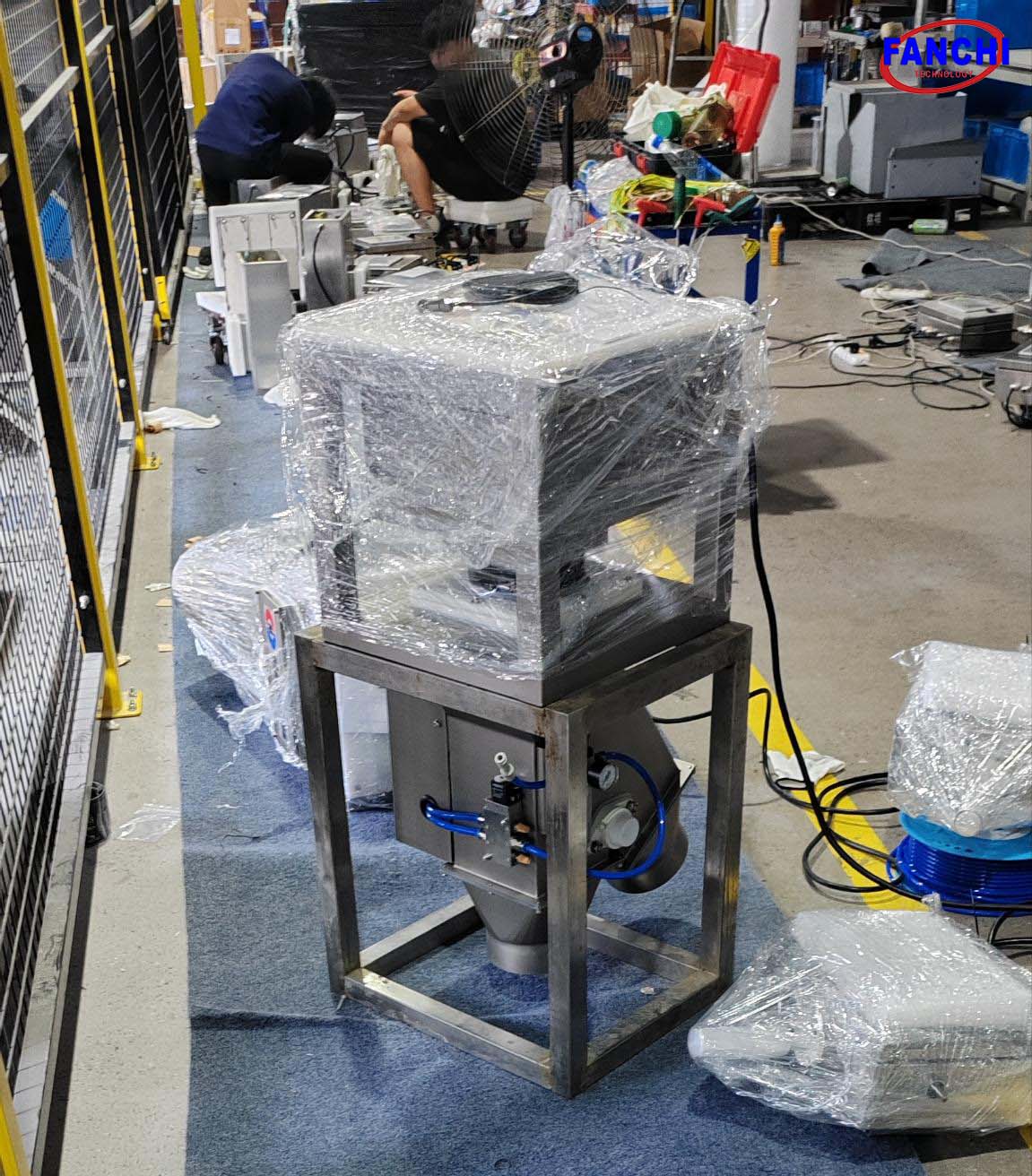
The dairy plant installed Fanchi-tech Gravity Fall (Throat) Metal Detectors on each of its four powder packaging lines, mounted directly between the product outlet hopper and the bag filling inlet.
Gravity fall metal detectors are purpose-built for free-flowing powders, granules, and fine bulk materials. As product falls vertically through the detection coil, the system continuously monitors for metal contaminants. When a metal particle is detected, a high-speed pneumatic reject valve diverts only the contaminated portion of the product stream into a rejection bin, while good product continues flowing normally into the packaging machine.
Core Detection Performance
The system detects all types of metallic contaminants in milk powder with high sensitivity:
- Ferrous metals: down to 0.3mm
- Non-ferrous metals (aluminum, copper, brass): down to 0.5mm
- Stainless steel (304/316): down to 0.8mm
Pneumatic Reject System
The integrated pneumatic blow-off reject mechanism is engineered specifically for fine powder applications. It features fast response times and precise diversion control, ensuring that only a minimal volume of product is rejected along with the contaminant. This design drastically reduces product waste compared to post-pack detection systems. The reject assembly includes a lockable collection bin and reject verification sensors for full process control.
Operational & Compliance Features
- Fully automatic operation with self-learning product effect compensation, adapting to different powder densities and moisture levels
- 100% product inspection at full production throughput
- Automatic data logging of all detection events, rejection events, and operational status with time and date stamps
- Food-grade 304 stainless steel construction with smooth, crevice-free surfaces suitable for dairy sanitation requirements
- Multi-level password protection to prevent unauthorized parameter changes
5. Machine Configuration Matching This Application
The Fanchi-tech gravity fall metal detector was selected and configured specifically to match the dairy plant’s production parameters:
- Installation type: Vertical throat-style design, mounted inline between the product hopper and packaging machine inlet, requiring no additional floor space
- Detection aperture: Standard round throat opening sized to match the existing 150mm powder transfer piping, with custom diameters available for different throughput requirements
- Throughput capacity: Handles the plant’s maximum output of up to 6 tons per hour per line, with no reduction in production speed
- Material contact surfaces: All product-contact parts constructed from food-grade 304 stainless steel with polished internal surfaces, meeting dairy hygiene requirements and supporting easy cleaning during production changeovers
- Pneumatic reject unit: Integrated blow-off rejector powered by 0.4–0.8MPa compressed air, with adjustable blow duration to minimize good product loss
- Environmental protection: Suitable for dry dairy processing environments, with sealed electronics to resist dust ingress
- Control interface: Intuitive digital control panel with LCD display, product parameter memory for multiple product recipes, and real-time production statistics
- Connectivity: Relay output for integration with plant SCADA systems, plus alarm outputs for audit and traceability purposes
All core electronic components are sourced from globally recognized suppliers for long-term reliability and consistent detection stability in 24-hour continuous production environments.
6. Application Process
The gravity fall metal detector is positioned as the final critical control point in the milk powder production flow, immediately upstream of packaging:
- Raw Milk Reception & Standardization: Raw milk is received, tested, pasteurized, and standardized for fat and protein content.
- Evaporation & Concentration: Milk is concentrated through multi-stage evaporation to achieve the required solids content.
- Spray Drying: Concentrated milk is atomized into the spray dryer, where hot air converts it into fine powder particles.
- Fluid Bed Drying & Cooling: Powder undergoes secondary drying and cooling to achieve target moisture content and temperature.
- Sieving: Powder passes through vibrating sieves to remove any oversized particles or agglomerates.
- Gravity Fall Metal Detection: Powder flows by gravity through the metal detector aperture. The system scans 100% of the product stream for ferrous, non-ferrous, and stainless steel contaminants.
- Automatic Rejection: Any portion of the product stream containing metal is automatically diverted by the pneumatic reject valve into a locked rejection bin. The rejection event is logged with a timestamp.
- Packaging: Accepted powder flows directly into the packaging machine for filling into retail pouches or 25kg bulk bags.
- Warehousing & Distribution: Sealed finished products are palletized and transferred to the warehouse for distribution.
7. Customer Benefits
Nine months after full deployment across all packaging lines, the dairy manufacturer reported measurable improvements across safety, compliance, and operational performance:
- Eliminated downstream metal contamination: No metal contaminants were detected in finished packaged product over the full monitoring period. The system successfully captured all test samples during regular validation testing, including 0.8mm stainless steel test spheres.
- Dramatically reduced product waste: The pneumatic reject system removes only a small quantity of powder per rejection event, compared to discarding entire 25kg bags. Product waste from metal rejection fell by approximately 85%, saving an estimated €45,000 per year in lost product value.
- Passed BRCGS audit with highest rating: The installation of pre-pack metal detection as a dedicated CCP allowed the plant to achieve BRCGS Grade A certification on its most recent audit, opening up new contracts with three major UK retail chains.
- Reduced production downtime: Eliminating bag rework freed up approximately 120 production hours per year across all lines, which the plant redirected to additional production output.
- Full traceability and audit readiness: Automatic event logging provides complete, tamper-proof records of all detection and rejection events. Quality managers can generate compliance reports in minutes, significantly reducing audit preparation time.
- Low total cost of ownership: The solid-state coil design and sealed electronics require minimal routine maintenance. Low power consumption and long service life deliver strong return on investment.
Shanghai Fanchi-tech Machinery Co., Ltd. is a specialized manufacturer of food inspection and quality control equipment with over 16 years of industry experience. Our products are deployed in food processing facilities across more than 50 countries worldwide.
- Application-optimized design: Our gravity fall metal detectors are engineered specifically for free-flowing powders and granular products, with coil geometry and reject mechanics optimized for minimal product loss and maximum detection stability.
- Broad contaminant detection: The systems reliably detect ferrous, non-ferrous, and stainless steel contaminants — including the fine stainless steel wear particles most common in dairy processing equipment.
- Food-grade construction: All product-contact surfaces use food-grade 304 stainless steel with hygienic design principles, making the systems suitable for dairy, infant nutrition, and other high-hygiene applications.
- Customizable configurations: Throat diameter, reject type, connection flanges, and control features can all be customized to match existing piping, hoppers, and packaging equipment.
- Global compliance: All systems carry CE certification and are designed to meet HACCP, BRCGS, and IFS audit requirements, supporting our customers’ export and retail certification needs.
- Reliable global support: We provide comprehensive documentation, remote technical assistance, and responsive after-sales support to customers worldwide.
9. FAQ
Q1: Can a gravity fall metal detector detect stainless steel in milk powder?
Yes, Fanchi-tech gravity fall metal detectors reliably detect all common metal types including ferrous metals, non-ferrous metals such as aluminum and copper, and 304/316 stainless steel. Stainless steel detection sensitivity in fine milk powder typically reaches 0.8mm for spherical test pieces.
Q2: Where should a metal detector be installed in a milk powder production line?
The most effective location is immediately before the packaging machine, after all processing and sieving steps are complete. This ensures that any metal introduced during drying, conveying, or sieving is removed before the product enters packaging, minimizing product loss.
Q3: How does the pneumatic reject system work with fine powder products?
When metal is detected, a high-speed pneumatic blow valve releases a precise burst of compressed air that diverts only the contaminated section of the falling product stream into a reject bin. The blow duration is adjustable to minimize the amount of good product rejected along with the contaminant.
Q4: Will milk powder product effect interfere with metal detection?
Fanchi-tech systems include automatic product effect compensation that learns the conductive and magnetic properties of the product. The system adjusts itself to accommodate normal variations in powder density, temperature, and moisture content, maintaining stable sensitivity without excessive false rejects.
Q5: Is this equipment suitable for dairy industry hygiene requirements?
Yes, all product-contact surfaces are constructed from food-grade 304 stainless steel with smooth, crevice-free finishes. The design supports quick disassembly for cleaning and inspection, aligning with standard dairy sanitation practices.
Q6: Does this metal detector support HACCP and BRCGS audits?
Yes. The system provides 100% inline inspection, automatic event logging with timestamps, password-protected settings, and reject verification — all features required to satisfy HACCP, BRCGS, IFS, and SQF audit criteria for metal detection as a critical control point.
Q7: Can the detector be fitted to our existing powder packaging line?
Yes, gravity fall metal detectors are designed for vertical inline installation between existing hoppers and packaging machines. Standard and custom throat diameters are available to match existing pipe and flange sizes, and installation typically requires no major line modifications.
Q8: What is the maximum throughput capacity of this system?
Throughput depends on throat diameter and product bulk density. For standard milk powder, typical throughput ranges from 1 to 10 tons per hour depending on aperture size. Custom configurations are available for higher-capacity industrial lines.
Q9: How often does the system require calibration?
Under normal operating conditions, the system maintains stable calibration for long periods. Most facilities perform sensitivity validation checks with certified test pieces at the start of each production shift or at changeover, following standard food safety protocols. Full recalibration is generally only required after major maintenance or product formulation changes.
Q10: Can detection data be exported to our plant quality management system?
Yes, the system supports relay outputs and optional data communication interfaces for integration with plant SCADA and quality management systems. Rejection events, run time, and other operational data can be logged centrally for traceability and reporting.
If you are looking for a reliable gravity fall metal detection solution for milk powder, whey powder, or other dairy ingredients, Fanchi-tech’s engineering team can provide a configuration matched to your production line requirements.
Shanghai Fanchi-tech Machinery Co., Ltd
Contact: Kerry
Email: kerry@fanchitech.net
Mobile/WhatsApp: +86 13917555254
Website: www.fanchitechnology.com
Post time: Aug-03-2026