


For food manufacturers handling large bags and heavy packaged products, weight inspection becomes increasingly difficult as production volumes increase. Manual weighing is slow, labor-intensive and difficult to maintain consistently across an entire production shift.
A heavy-duty dynamic checkweigher provides a different approach: every finished package can be weighed automatically while moving through the production line, allowing underweight and overweight products to be identified without stopping the conveyor.
This application case study examines how a Fanchi-tech heavy-duty dynamic checkweigher can be configured for 25 kg flour bags and other large-format food packages.
Application: Flour and dry food packaging
Target product: Up to 25 kg packaged bags
Inspection: Dynamic weight verification
Production stage: End-of-line packaging
Machine type: Heavy-duty inline checkweigher
1. Industry Background: Why Weight Control Matters in Flour Packaging
Flour, starch, grain products and other dry food ingredients are commonly packaged in medium and large bags for food manufacturers, wholesalers and industrial customers.
For a 25 kg package, even a relatively small filling deviation can create significant material giveaway when multiplied across thousands of bags.
At the same time, underweight products can create customer complaints, shipment disputes and compliance problems.
For manufacturers supplying international markets, accurate net quantity control is particularly important. EU rules for prepacked products establish harmonised requirements for filling and quantity control, while the net quantity of prepacked food must be clearly indicated to consumers.
Food manufacturers also operate within broader food-safety management systems. FDA guidance identifies physical hazards such as metal and other foreign materials as food-safety concerns and recognises inspection technologies such as metal detectors and X-ray systems as potential controls.
For this reason, weight inspection should not be considered only a weighing function. It can become an important part of the overall production line quality control system.
2. Customer Production Challenges
Consider a flour manufacturer producing large bags for commercial food customers.
The production line may include:
Flour Processing → Filling → Bag Sealing → Conveyor Transfer → Weight Inspection → Reject → Palletizing
The typical package formats could include:
- 5 kg flour bags
- 10 kg flour bags
- 20 kg flour bags
- 25 kg flour bags
The main challenges are not simply “how to weigh the bag”.
The real production questions are:
Can every bag be checked?
Manual sampling only checks a portion of production. If the line is running continuously, operators cannot practically weigh every package while maintaining high throughput.
Can heavy bags be weighed stably?
A 25 kg bag has significantly more momentum than a small snack pouch. Bag deformation, uneven loading and conveyor vibration can influence weighing stability.
Can the checkweigher integrate with the existing conveyor?
Many large-package food lines already use roller conveyors or customised transfer sections. Replacing the entire conveyor system can increase installation costs and downtime.
What happens when a package is outside the target weight?
An automatic reject system is required to remove non-conforming products from the production flow without stopping the line.
3. Why Manual or Sampling Weighing Is Not Enough
Traditional manual weighing creates several limitations.
First, it requires operators to repeatedly lift and place heavy bags onto a scale. This increases labour requirements and makes the process physically demanding.
Second, sampling inspection does not provide continuous control.
A production line may manufacture hundreds or thousands of bags during a shift, while only a small proportion may be manually checked.
Third, manual records are difficult to connect with real-time production data.
If the filling machine gradually begins to overfill, operators may not discover the problem until a significant amount of product has already been consumed as giveaway.
A dynamic checkweigher changes the inspection point from:
Manual Sampling
to:
100% Inline Weight Verification
The principle is simple:
Package enters → Product is weighed while moving → Weight is evaluated → Pass or Reject
4. Fanchi-tech Heavy-Duty Dynamic Checkweigher Solution
For this type of application, Fanchi-tech’s FA-CW heavy-duty dynamic checkweigher is designed for large and heavy packaged products.
The product range includes configurations intended for bags, boxes, cases and other large end-of-line packages. The FA-CW500 configuration published by Fanchi-tech provides a weighing range of 0.1–25 kg, a 1 g scale interval and a published detection speed of up to 40 pieces per minute.
The machine uses a high-precision load cell and dynamic weight tracking technology to calculate product weight while the package is moving through the weighing section.
This eliminates the need to manually stop each package for weighing.
The system can also be equipped with an automatic rejector so that products outside the defined weight limits can be separated from conforming products.
5. Machine Configuration Matching the Flour Bag Application
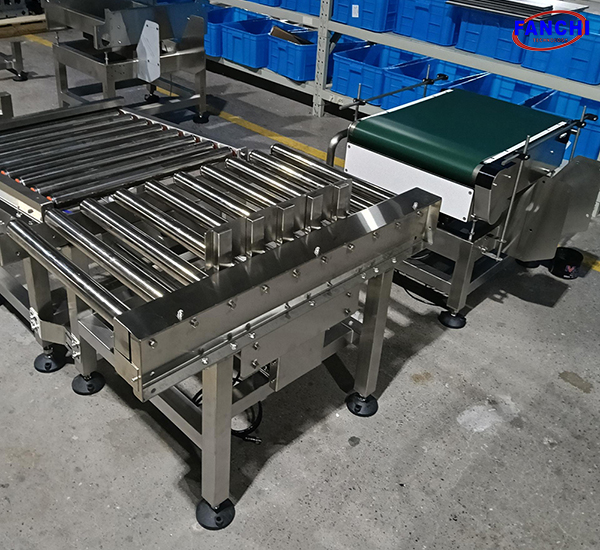
The equipment shown in the supplied installation photo has a particularly relevant configuration for heavy-package production lines.
The system combines a roller conveyor transfer section with a belt-based weighing section, allowing large products to move smoothly through the inspection area.
For the FA-CW500 configuration, the published specifications include:
| Configuration | FA-CW500 |
|---|---|
| Weighing Range | 0.1–25 kg |
| Scale Interval | 1 g |
| Published Accuracy | ±10 g |
| Published Speed | Up to 40 pcs/min |
| Weighing Conveyor | 500 × 600/800 mm |
| Construction | Stainless Steel 304 |
| Conveyor Belt | PU anti-static |
| Weigh Sensor | High-precision load cell |
| Rejector | Heavy-duty pusher |
| HMI | 7-inch LCD touchscreen |
| Product Memory | Up to 100 products |
For a 25 kg flour bag application, the most important matching factors are not simply the maximum weighing capacity.
The engineering team should also confirm:
- Bag dimensions
- Bag material
- Bag shape after filling
- Product centre of gravity
- Required line speed
- Conveyor height
- Infeed and outfeed conveyor design
- Required reject distance
- Available floor space
- Cleaning requirements
The final machine configuration should therefore be confirmed using the customer’s actual product samples and production-line layout.
6. How the Application Works
A typical production process can be arranged as:
Flour Filling
↓
Bag Sealing
↓
Roller Conveyor Transfer
↓
Heavy-Duty Dynamic Checkweigher
↓
Weight Evaluation
↓
Automatic Reject
↓
Qualified Product
↓
Palletizing / Shipping
When a bag enters the weighing section, the photoelectric sensor identifies the product and the weighing system captures the dynamic weight while the bag continues moving.
The control system compares the measured value with the preset target weight and tolerance.
For example:
Target Weight: 25 kg
A manufacturer can define its acceptable weight limits according to its internal quality system and applicable market requirements.
If the measured weight falls outside the configured range, the system sends a signal to the reject mechanism.
The rejected bag is then separated from the normal production flow.
This creates a continuous inspection process without requiring an operator to stop the conveyor for each package.
7. Automatic Reject System for Heavy Packages
Rejecting a 25 kg package requires a different approach from rejecting a small snack pouch.
The reject mechanism must be selected according to:
- Product weight
- Bag dimensions
- Conveyor speed
- Product spacing
- Bag material
- Downstream conveyor arrangement
For heavy products, Fanchi-tech provides heavy-duty pusher-type rejection options within its checkweigher configurations.
The objective is not simply to “remove the bad product”.
The reject system should:
- Remove the incorrect package reliably.
- Avoid damaging acceptable packages.
- Prevent rejected products from returning to the good-product stream.
- Maintain continuous production.
- Provide a clear separation between qualified and rejected products.
This is particularly important in food factories where a rejected package must be clearly identified and controlled.
8. From Weight Inspection to Production Optimization
One of the most valuable functions of an online checkweigher is that it can provide more than a simple pass/fail result.
Weight data can help production engineers understand filling performance.
For example, if the average weight gradually moves above the target:
Target → Actual Weight → Trend → Filling Adjustment
the filling machine can potentially be adjusted before excessive material giveaway accumulates.
This creates a feedback loop between:
Filling Equipment
and
Checkweighing System
Instead of discovering filling problems at the end of a production shift, manufacturers can use real-time weight information to improve process control.
This is one reason dynamic checkweighing is increasingly used as part of automated food packaging lines.
9. Food Safety and Quality Control
A checkweigher does not replace a metal detector or X-ray inspection system.
Its primary purpose is weight verification.
For a food manufacturer, a complete end-of-line inspection system may therefore combine multiple technologies:
Checkweigher
Verifies:
- Underweight products
- Overweight products
- Filling consistency
- Missing-product conditions in suitable applications
Metal Detector
Detects metal contamination such as:
- Ferrous metal
- Non-ferrous metal
- Stainless steel
X-ray Inspection System
Depending on product and packaging characteristics, X-ray inspection can be used to detect foreign materials and other quality issues.
FDA food-safety guidance recognises metal and other extraneous materials as physical hazards and identifies metal detectors and X-ray systems among available detection technologies.
This is why Fanchi-tech can also provide Combination Inspection Systems integrating weighing and metal detection for suitable applications. Fanchi-tech’s published combination systems are designed to combine dynamic weighing and metal detection in one production-line solution.
10. Key Benefits for Large-Package Food Manufacturers
A heavy-duty dynamic checkweigher can provide several operational benefits.
100% Inline Weight Inspection
Every package can be checked while moving through the production line instead of relying only on manual sampling.
Reduced Manual Weighing
Operators no longer need to repeatedly stop and weigh heavy bags manually.
Better Weight Consistency
Continuous measurement provides production teams with better visibility of filling performance.
Reduced Product Giveaway
Accurate weight data can help manufacturers identify excessive filling and optimise filling-machine settings.
Automatic Rejection
Underweight or overweight products can be automatically separated from the qualified product stream.
Production-Line Integration
The checkweigher can be configured around existing conveyor heights, product dimensions and production-line layouts.
Better Traceability
Fanchi-tech’s published FA-CW specifications include product memory and USB data retrieval, with Ethernet available as an option.
11. Why Choose Fanchi-tech for Custom Checkweighing Solutions?
Choosing an industrial checkweigher is not simply a matter of comparing maximum capacity.
The correct system depends on the complete production environment.
Fanchi-tech provides industrial inspection equipment including:
- Industrial Metal Detectors
- Dynamic Checkweighers
- X-ray Inspection Systems
- Combination Inspection Systems
- Conveyor and production-line integration
The company also offers customized configurations based on product characteristics and existing line layouts. Its published checkweigher range includes standard, heavy-duty and combination configurations.
For international food manufacturers, the engineering discussion should therefore start with:
What product are you weighing?
rather than:
Which checkweigher do you want to buy?
Before recommending a configuration, Fanchi-tech can evaluate:
- Product weight
- Product dimensions
- Packaging material
- Conveyor speed
- Line height
- Available installation space
- Required accuracy
- Reject method
- Cleaning requirements
- Communication requirements
This approach helps ensure that the inspection system is matched to the actual production line rather than selected from a generic specification sheet.
12. Application Summary
For a production line packaging flour or other dry food products in packages up to approximately 25 kg, a heavy-duty dynamic checkweigher can provide a practical solution for continuous weight verification.
The key concept is:
Filling → Conveying → Dynamic Weighing → Automatic Reject → Qualified Product
Instead of relying on manual sampling, manufacturers can introduce continuous weight inspection directly into the production line.
For larger packages, the mechanical design is just as important as the weighing electronics. Stable conveying, appropriate weighing-platform dimensions, product spacing and a suitable reject mechanism all contribute to reliable inspection.
For applications outside the standard FA-CW500 range, Fanchi-tech can also evaluate larger weighing capacities and customized conveyor configurations.
FAQ
1. What is a heavy-duty dynamic checkweigher?
A heavy-duty dynamic checkweigher automatically measures the weight of large or heavy products while they are moving through a production line. It can identify products outside preset weight limits and trigger an automatic reject system.
2. Can a checkweigher inspect 25 kg flour bags?
Yes. Fanchi-tech’s published FA-CW500 configuration has a weighing range of 0.1–25 kg, making it suitable for applications around this package-weight range, subject to product dimensions and line conditions.
3. What products can a heavy-duty checkweigher inspect?
Typical applications include:
- Flour bags
- Rice bags
- Pet food bags
- Large food bags
- Cartons
- Cases
- Barrels
- Frozen food packages
- Bulk packaged products
Fanchi-tech specifically positions its heavy-duty checkweighers for large packages, bags, boxes, cases and other end-of-line products.
4. Can the checkweigher be connected to an existing conveyor?
Yes. The conveyor configuration, line height and transfer sections can be designed around the existing production line. The exact connection should be confirmed using conveyor dimensions and product samples.
5. Does a checkweigher detect metal contamination?
No. A standard checkweigher primarily verifies product weight. If metal contamination detection is also required, a combination system integrating a metal detector and checkweigher can be considered.
6. Can a checkweigher automatically reject underweight products?
Yes. Fanchi-tech’s heavy-duty checkweigher configurations can use automatic reject mechanisms such as heavy-duty pusher systems.
7. What accuracy can a heavy-duty checkweigher achieve?
The published FA-CW500 specification lists a scale interval of 1 g and an accuracy of ±10 g. Actual production performance depends on product characteristics, conveyor conditions, speed, vibration and installation.
8. Can a checkweigher reduce product giveaway?
Yes. Continuous weight measurement can provide production teams with real-time information about filling performance. This can help identify overfilling and support adjustments to upstream filling equipment.
9. Can the checkweigher be used for food production?
Yes. Fanchi-tech offers food-oriented checkweighing configurations using stainless-steel construction and food-grade conveyor components. The final hygienic and cleaning configuration should be selected according to the customer’s food-processing environment.
10. How do I choose the right checkweigher?
The key factors are:
Product weight + product dimensions + conveyor speed + packaging material + line height + required accuracy + reject method + installation environment.
The best configuration should be determined from actual product samples and production-line requirements.
Post time: Sep-02-2026