


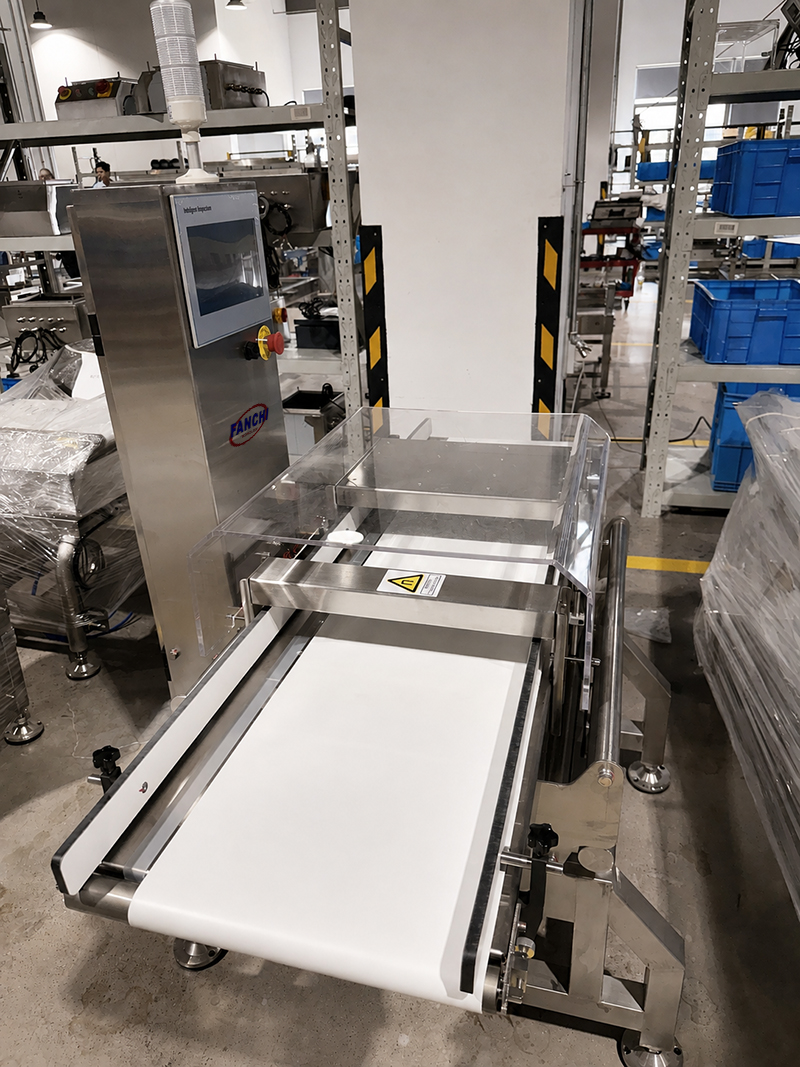
Aluminum Foil Conveyor Metal Detector Application Case Study: Improving Safety and Quality Control in Ready-to-Eat Meal Industry
1. Industry Background
The global ready-to-eat (RTE) meals market has maintained steady growth over the past decade, driven by rapid urbanization, fast-paced lifestyles, and rising consumer demand for convenient, nutritionally balanced packaged food in North America and Western Europe. According to industry statistics, the European ready meal market alone exceeds €25 billion annually, with chilled and frozen foil-packaged meals accounting for more than 45% of total sales volume.
Alongside market expansion, food safety regulatory systems have become increasingly stringent. Authorities including the U.S. FDA, EU EFSA and GFSI have all upgraded foreign body control requirements for processed food products. HACCP, BRCGS and IFS Food standards explicitly identify metal detection as a mandatory Critical Control Point (CCP) in packaged food production lines, requiring manufacturers to implement 100% in-line inspection and retain traceable quality records.
Aluminum foil trays and laminated foil films have become the dominant packaging format for ready meals due to their excellent heat resistance, oxygen barrier performance and microwave adaptability. However, this widely adopted packaging creates a major technical challenge for quality control: conventional Metal Detector equipment cannot distinguish the conductive signal of aluminum packaging from actual metal contaminants inside the product. This leads to either massive false rejects that cripple production efficiency, or undetected contamination that exposes brands to recall risks. For ready meal manufacturers targeting export markets, deploying a professional Aluminum Foil Metal Detector has become a necessary investment to maintain compliance and competitive advantage.
2. Customer Production Challenges
This case is based on a mid-sized ready-to-eat meal manufacturer located in Germany, specializing in chilled ethnic cuisine and classic European prepared meals. The company operates three high-speed packaging lines, running 16 hours per day, six days per week, supplying products to major supermarket chains and catering service providers across the EU.
Product & Production Profile
- Product range: Pasta dishes, beef stews, vegetable curries and grain bowls, all packaged in rectangular aluminum foil trays with heat-sealed foil lids
- Unit weight: 200g to 1.5kg per tray, with most SKUs in the 300–500g range
- Production speed: 32–38 trays per minute per line, equivalent to approximately 35m/min conveyor speed
- Annual output: Over 12 million units per year
Contamination Risk Sources
Metal contamination risks exist throughout the production workflow:
- Raw material stage: Frozen meat blocks may contain small metal fragments from processing equipment; dried spices and grain ingredients occasionally carry metal shavings from milling and grinding machinery
- Processing stage: Stainless steel mixing bowls, cutting blades and conveyor parts can generate micro metal wear particles during long-term operation; loose screws, wire fragments and tool parts may also accidentally fall into product batches
- Packaging stage: Foil tray forming equipment and sealing machines carry inherent metal part wear risks
Pre-existing Problems
Before cooperating with Fanchi-tech, the customer used standard conveyor metal detectors purchased from a local supplier. The equipment generated persistent false alarms triggered by the aluminum foil packaging, with a false rejection rate as high as 28%. This caused frequent production pauses, excessive product waste and extra manual re-inspection workload.
Worse still, the manufacturer experienced two minor product recall incidents within 12 months, caused by undetected stainless steel wire fragments in foil-packed meals. The incidents resulted in direct financial losses of over €120,000, plus lasting damage to brand reputation and retailer trust. The customer urgently needed a professional food safety inspection equipment solution that could reliably inspect foil-packaged products.
3. Why Traditional Inspection Methods Were Not Enough
The customer had tried multiple alternative inspection methods before adopting our solution, all of which failed to meet practical production requirements:
Manual Visual Inspection
The company once assigned two quality inspectors per line to visually check products before case packing. However, manual inspection can only identify large, visible metal pieces on product surfaces; it cannot detect contaminants embedded inside food or hidden under foil lids. At line speeds above 30 units per minute, manual detection accuracy drops below 55%, and long-term work leads to visual fatigue and missed defects. The method is also labor-intensive and fails to provide objective, traceable quality records required for certification audits.
Standard Conveyor Metal Detector
General-purpose food metal detectors operate on basic coil balance principles. They cannot differentiate the conductive effect of aluminum packaging from actual metal contaminants inside the product. Every foil tray passing through the detection channel triggers an alarm, making normal production impossible. Some manufacturers attempt to reduce sensitivity to suppress false alarms, but this directly lowers detection capability for small contaminants and defeats the purpose of inspection.
Batch Sampling & Lab Testing
Off-line laboratory testing can achieve high detection accuracy, but it is time-consuming, expensive and only covers a tiny fraction of production output. Sampling inspection cannot provide real-time quality control, and contamination incidents in unsampled batches will still reach the market. For high-volume continuous production lines, sampling is essentially a passive risk mitigation measure rather than an effective quality control solution.
X-ray Inspection Systems
While X-ray systems can inspect foil-packaged products, their purchase cost is 3–4 times higher than dedicated foil metal detectors, and they require specialized operator training, regular radiation safety testing and complex maintenance. For manufacturers whose primary foreign body risk is metal contamination, X-ray systems represent unnecessary over-investment and operational complexity.
4. Fanchi-tech Solution
After on-site production line assessment, product sample testing and technical communication, Fanchi-tech provided the customer with our FC-AL Series Aluminum Foil Conveyor Metal Detector, a purpose-built automatic reject metal detector solution engineered specifically for foil-packaged food products.
Detection Principle
The system adopts advanced digital phase balance technology combined with dual-frequency detection algorithms. By precisely adjusting the detection phase angle, the equipment actively filters out the background conductive signal generated by aluminum foil packaging, while retaining high sensitivity to actual metal contaminants inside the product. The intelligent algorithm can automatically adapt to different foil thicknesses, tray sizes and product formulations, ensuring stable performance across the customer’s full SKU range.
Core Performance Specifications
- Detection capability: Achieves 0.8mm Fe, 1.2mm non-ferrous metal and 1.5mm 316 stainless steel detection sensitivity for standard 300g aluminum foil tray meals
- Processing speed: Supports conveyor speeds from 10 to 60 meters per minute, fully matching the customer’s 35m/min production line speed
- Automatic reject system: Integrated pneumatic pusher reject mechanism with 0.3 second response time, automatically pushing contaminated products into a dedicated locked reject bin without stopping production
- Control system: 7-inch color touchscreen HMI, supporting up to 100 product recipe presets, real-time production data statistics, fault self-diagnosis and inspection log export functions
Line Integration Solution
The detector adopts a modular conveyor design with adjustable inlet/outlet heights (750–900mm). It can be directly docked with the customer’s existing foil sealing machine output conveyor without major line modification. Installation and commissioning were completed during a single weekend production shutdown, causing zero disruption to normal production schedules. The equipment also provides standard I/O signal interfaces for seamless connection to upstream and downstream equipment, forming a fully automated packaging line inspection system.
5. Machine Configuration Matching This Application
The FA-MD series detector configuration was fully customized to match the customer’s product characteristics and production environment, with key parameters as follows:
Conveyor Width
The equipment is equipped with a 350mm effective width food-grade PU conveyor belt, which perfectly matches the customer’s 200×150mm to 300×220mm aluminum foil tray specifications. The belt features a smooth, non-stick surface that meets EU food contact material standards, with easy disassembly design for regular cleaning and sanitation.
Detection Aperture
The rectangular detection channel measures 350mm wide × 150mm high, accommodating all single-tray products in the customer’s portfolio. The internally wound detection coil adopts an optimized structural design, ensuring uniform sensitivity distribution across the entire channel cross-section, eliminating detection blind spots at edges and corners.
Product Weight Range
The system supports inspected products weighing from 10g to 3kg, fully covering the customer’s 200g to 1.5kg ready meal weight range. The built-in automatic product learning function can quickly adapt to different product weights and densities without manual sensitivity recalibration.
Product Speed Compatibility
Conveyor speed is continuously adjustable via frequency conversion control, with a speed range of 10–60m/min. The detector’s signal processing system maintains stable detection accuracy across the full speed range, and supports speed synchronization with the customer’s packaging line via encoder signal input.
Material & Protection Design
The entire machine frame, conveyor rollers and product contact parts are made of 304 food-grade stainless steel with brushed finish, featuring rounded corner design and no sanitary dead corners, meeting IP65 protection grade for the detection head and IP54 for the control cabinet. The detection head is fitted with a transparent acrylic protective cover (visible in the equipment image) to prevent product spillage from contaminating internal components, while allowing operators to visually monitor the inspection process in real time.
Installation Method
Floor-standing installation with four adjustable stainless steel support feet, enabling stable placement on workshop floors and convenient height leveling. The equipment is suitable for both dry and wet food processing environments, with corrosion-resistant structure that withstands regular wash-down cleaning procedures.
6. Application Process
The metal detection station is integrated as the final quality control checkpoint in the ready meal production flow, positioned immediately after the foil sealing machine and before secondary case packing. The complete production workflow is as follows:
Raw Material Receiving & Inspection → Pre-processing (Cutting, Cooking, Mixing) → Aluminum Foil Tray Filling → Foil Heat Sealing & Date Coding → In-line Conveyor Metal Detection → Automatic Rejection of Contaminated Products → Case Packing → Palletizing → Finished Product Warehousing
During operation, sealed foil trays enter the detector conveyor at a constant speed from the sealing machine. When a product passes through the detection channel, the system performs real-time signal analysis. If any metal contaminant is identified, the controller sends a trigger signal to the pneumatic reject mechanism after a precise time delay calculated based on conveyor speed. The pusher then pushes the non-conforming product horizontally into a dedicated locked reject collection bin.
The entire inspection and rejection process is fully automated with zero manual intervention. The system records every detection event, reject event and parameter adjustment in real time, generating timestamped quality logs that can be exported in CSV format for traceability and third-party audit purposes.
7. Customer Benefits
After 12 months of stable operation, the customer achieved significant improvements across multiple operational dimensions:
Reduced Contamination Risk
The equipment achieved a 99.98% metal contaminant detection rate in actual production, successfully capturing multiple test pieces and naturally occurring metal fragments during daily sensitivity verification. No metal contamination customer complaints or product recall incidents have occurred since installation, effectively eliminating food safety risks.
Improved Production Efficiency
The false rejection rate dropped from the original 28% to below 0.4%, greatly reducing product waste and production downtime caused by false alarms. Overall line efficiency increased by 16.5%, equivalent to an additional 1.2 million units of annual production capacity per line without increasing equipment investment.
Reduced Operational Costs
Automated 100% inspection eliminated the need for manual visual re-inspection, saving 2 full-time quality inspector positions per production line. The reduction in product waste also translates to annual raw material cost savings of approximately €75,000.
Compliance & Certification Support
The equipment fully meets HACCP, BRCGS and IFS Food standard requirements, with complete data logging and audit trail functions. The customer successfully passed its annual BRC certification audit with zero non-conformances related to foreign body control.
Enhanced Export Competitiveness
Reliable metal inspection capability and complete compliance documentation enabled the customer to successfully enter the UK and Scandinavian markets with stricter food safety requirements. Export revenue increased by 23% in the first year after equipment installation.
8. Why Choose Fanchi-tech
Shanghai Fanchi-tech Machinery Co., Ltd. is a professional manufacturer specializing in food safety inspection and production quality control equipment. We are committed to providing high-performance, cost-effective inspection solutions for food processing enterprises worldwide.
Deep Industry Expertise
With over 10 years of focus on the food inspection sector, we have accumulated rich application experience across ready meals, meat processing, bakery, dairy, snack food and other segments. Our inline food metal detector and checkweigher product lines cover all mainstream production inspection scenarios.
Global Service Network
We have delivered more than 2,000 sets of equipment to customers in over 30 countries and regions. Through local service partners across Europe, North America and Southeast Asia, we provide on-site installation, commissioning, operator training and after-sales maintenance services.
Customized Solution Capability
We understand that every production line is unique. Our technical team provides customized configurations including conveyor size, detection sensitivity, reject system type and control functions according to customer product characteristics, packaging format and production line layout.
Strict Quality Standards
All Fanchi-tech products comply with CE safety certification and ISO 9001 quality management system standards. All product contact parts use food-grade certified materials, and each piece of equipment undergoes 72 hours of continuous operation testing before delivery.
Long-term Technical Support
We provide 12-month standard warranty, lifetime technical support and regular software upgrade services. Our technical team responds to customer consultation requests within 24 hours, ensuring stable long-term equipment operation.
9. FAQ
Q: Can this aluminum foil metal detector inspect both foil trays and foil bag packaged products? A: Yes, this Conveyor Metal Detector is designed for all types of aluminum foil packaged products, including foil trays, foil pouches and aluminum-laminated film bags. It effectively filters aluminum conductive interference while detecting internal metal contaminants.
Q: What types of metal contaminants can be detected in ready-to-eat meals? A: The detector can identify all common production metal contaminants including iron, carbon steel, 304/316 stainless steel, copper, brass and aluminum fragments. Actual detection sensitivity depends on product size, weight and packaging thickness.
Q: How accurate is the detection sensitivity for standard foil tray meals? A: For 300–500g aluminum foil tray ready meals, typical detection sensitivity reaches 0.8mm Fe, 1.2mm non-ferrous metal and 1.5mm 316 stainless steel. We provide free sample testing to confirm actual performance for your specific products.
Q: Can the conveyor speed be synchronized with our existing packaging line? A: Yes, the equipment supports encoder speed synchronization input and can automatically match line speeds from 10 to 60m/min. It can also be connected to upstream equipment via I/O signals for integrated control.
Q: Does this equipment meet HACCP and BRC audit requirements? A: Yes, our foil metal detector fully complies with HACCP, BRCGS, IFS Food and GFSI standards. It supports product recipe management, inspection event logging and audit trail export functions required for third-party certification.
Q: What kind of reject system does the machine use? A: The standard configuration is a pneumatic pusher reject system, suitable for boxed and rigid bagged products. We also offer optional air blast, diverter and drop-through reject systems for different product types and production line layouts.
Q: Can the detector be integrated into our current production line without major modification? A: Yes, the equipment adopts standard conveyor interface design with adjustable inlet/outlet height. It can be directly docked with most filling, sealing and packaging lines, usually requiring only simple conveyor connection without layout reconstruction.
Q: What is the maximum product size and weight this model supports? A: This standard 350mm width model supports products up to 300mm wide, 150mm high and 3kg in weight. We also offer 450mm and 600mm wider models for larger products or multi-pack formats.
Q: Do you provide on-site installation and training services in Europe? A: Yes, we have local service partners in major European countries that provide on-site installation, commissioning and operator training services. We also offer remote technical support via video call for daily troubleshooting.
Q: What daily maintenance does the aluminum foil metal detector require? A: Daily maintenance includes wiping the conveyor belt and detection channel with food-grade detergent, checking reject mechanism operation, and performing sensitivity verification with standard test pieces. A detailed maintenance manual is included with equipment delivery.
Post time: Sep-04-2026